Know what you can promise, before you promise it
In a factory of 20–200 people, the same three questions come up every week: when will it be ready, what does it cost us, why did it come out wrong. The answers are already on the shop floor — in the orders, the time logs, the material consumption, the machine stoppages. The platform collects them as they happen, not at the end of the month.
- Every product can tell you its way back
- See who is working on what, right now
- Machines don't stop you in the week with deliveries
- You ask in your own words, it answers from your own data
What happens today, without a system
You promise deadlines without knowing your real capacity
The customer asks when it will be ready, and the answer comes from memory: who is free, which machine is busy, how long a similar order took last time. What you promised is never compared with what actually happened, so the second time you get it wrong the same way.
The cost per product shows up after you have delivered
Material leaves the warehouse, hours are written on a slip, scrap is deducted nowhere. The real cost of an order reaches accounting the following month — when the price is already quoted, the goods are already shipped and the margin is already gone.
Scrap has no cause, only someone to blame
The part came out wrong. Nobody knows on which machine, on which shift, from which material lot, following which version of the procedure. Without that, the discussion ends with “let's be more careful”, and a month later it happens again.
One machine stopping stops the whole flow
The machine is down, the orders queued behind it are down with it, and postponed servicing takes its revenge in exactly the week with deliveries. Nobody remembers when the next service was due, because it is remembered by people, not by a system.
The capabilities, written in your language
They are the same eight capabilities everywhere; only the names of the things they track change. Where there is a screenshot, it is from the real application, with real data.
- 01Traceability of the work
Every product can tell you its way back
The finished product is linked to the lots it came from, the steps it went through and the people who carried them out. The link is made at the moment of execution, by scanning, not by filling in a register at the end of the day. The code it leaves the factory with is the same one you search back on two years later, when a complaint arrives.
The same rule applies to machines: each machine's record holds the list of completed interventions, with the order number, the procedure they followed and the date they were finished.
Traceability of the work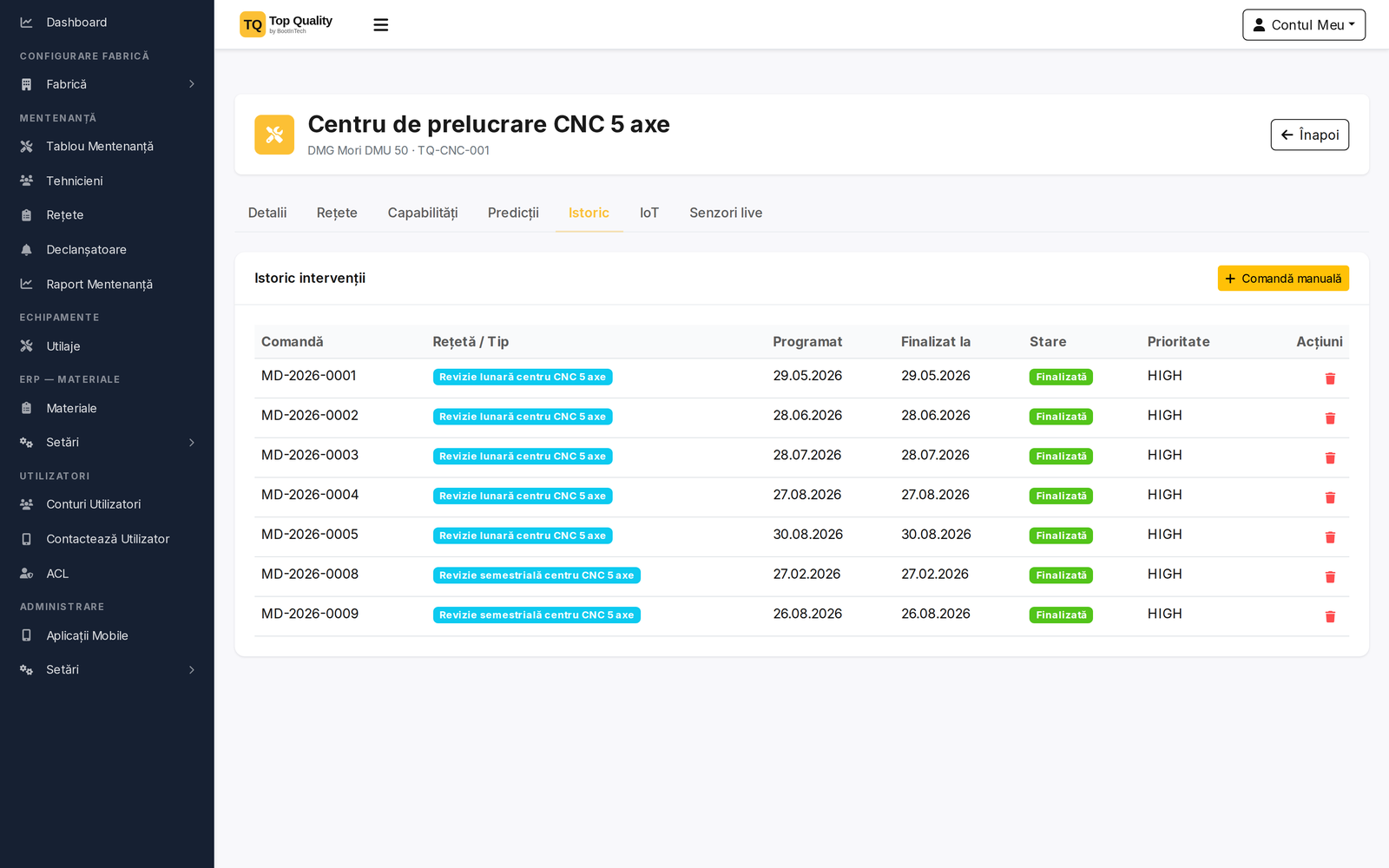
- 02Efficiency of your people
See who is working on what, right now
Every person carries their own jobs on a phone or a tablet, on the floor: scan the workstation, start the step, finish it, record the material used. Time is measured on each step, not declared at the end of the day.
One screen shows the team: who is working and for how long, who has a job assigned and has not started it, who is free. The job opens from the same card.
Efficiency of your people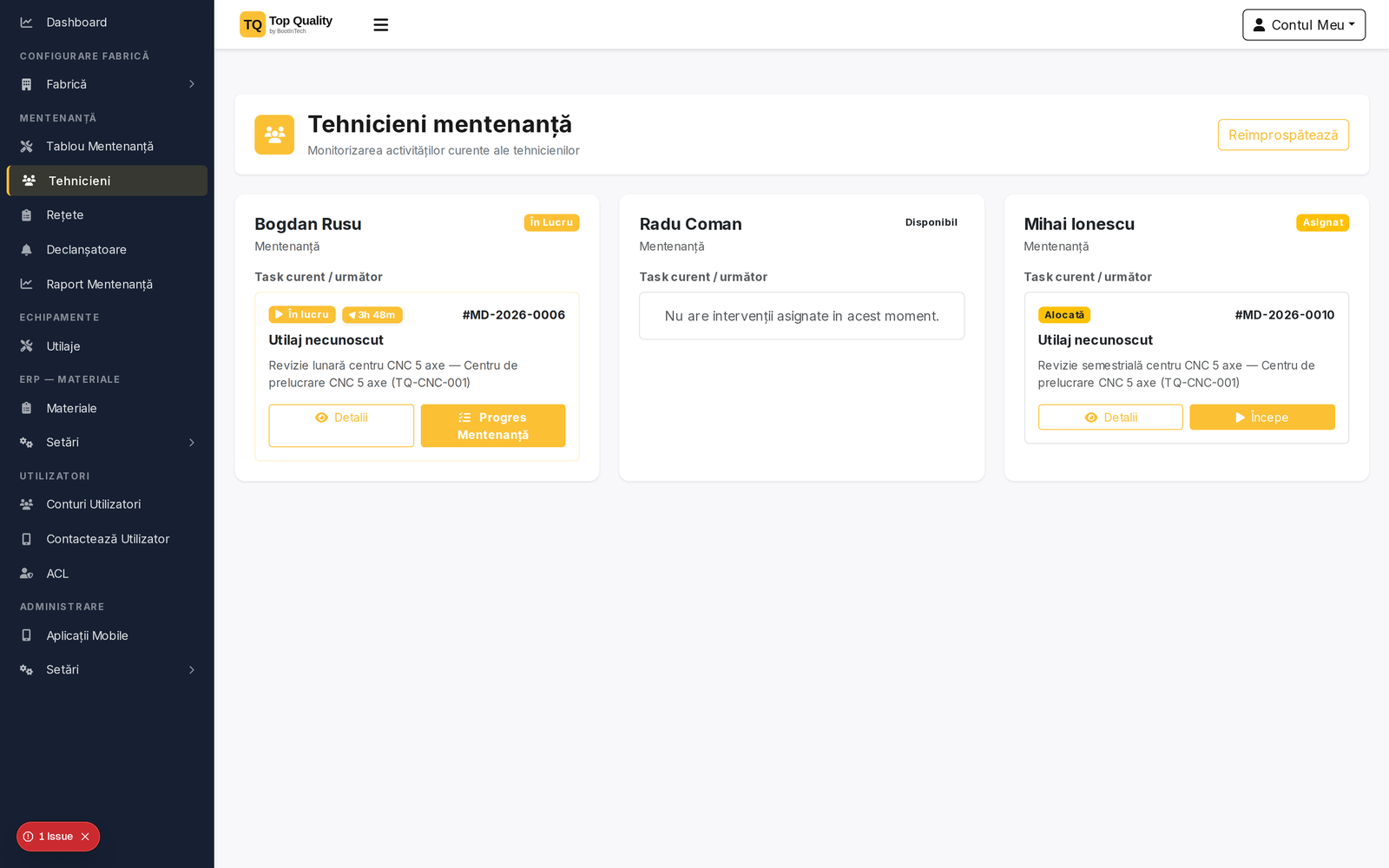
- 03Machine and tool maintenance
Machines don't stop you in the week with deliveries
The whole fleet in one list, with the next service on every row. What has fallen behind is visible, not something you hear from an operator. Every machine has its own written procedure, step by step, with the materials each step needs — and the procedure is not deleted when it changes: it is archived, and the new one starts from a copy.
The fleet list shows the internal code, the manufacturer, the model, the status and the maintenance due date, with overdue rows marked in red.
Machine and tool maintenance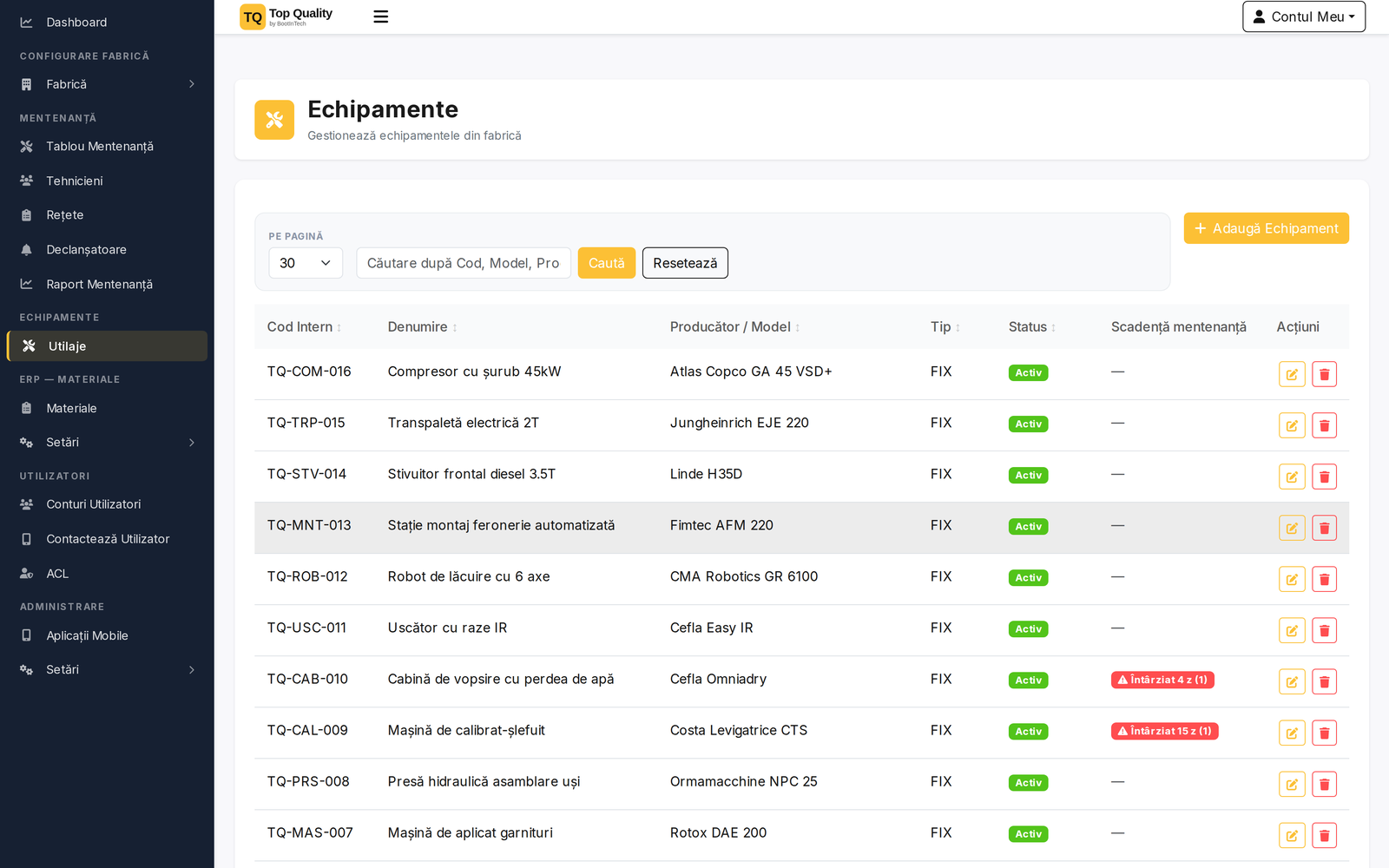
- 04AI models on your own data
You ask in your own words, it answers from your own data
The assistant reads machine status and due jobs from your own database, not from a general model that guesses. “Which services are due this week on the cutting line” is a question with an answer, not a report you have to ask someone for.
What it produces is visible even without asking: every machine has its predictions tab, with the services due in the next 90 days, the materials needed and their cost worked out in advance.
- 05Preventive alerts
What comes next schedules itself
The rules are written once — the procedure, the machine, the interval — and from there the jobs are scheduled without anyone asking for them. The same for materials: below the reorder point, the system proposes the purchase instead of waiting for someone to remember.
The trigger list shows, for each rule, the machine, the due date and the interval, and anything past its date appears as overdue.
Preventive alerts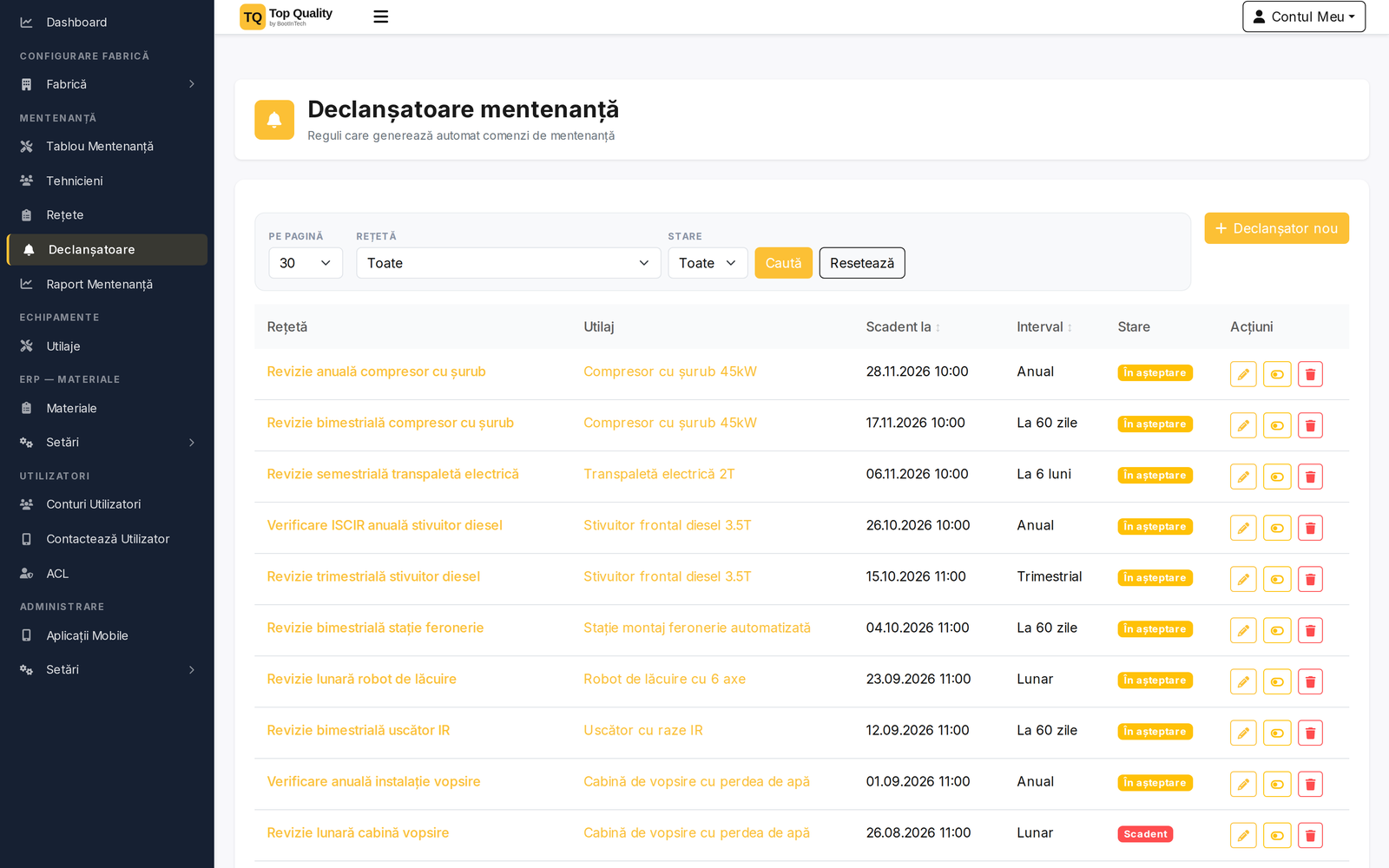
- 06Real-time reporting
The month's numbers, on the day they happen
Material cost, labour and consumption add up as the work is done. The report is not assembled at month end from a file one person keeps; it is read whenever you want, over the range you choose.
A single screen shows the consumption of every material over the chosen range, real cost next to estimated cost, broken down by month and by the machines that consumed it.
Real-time reporting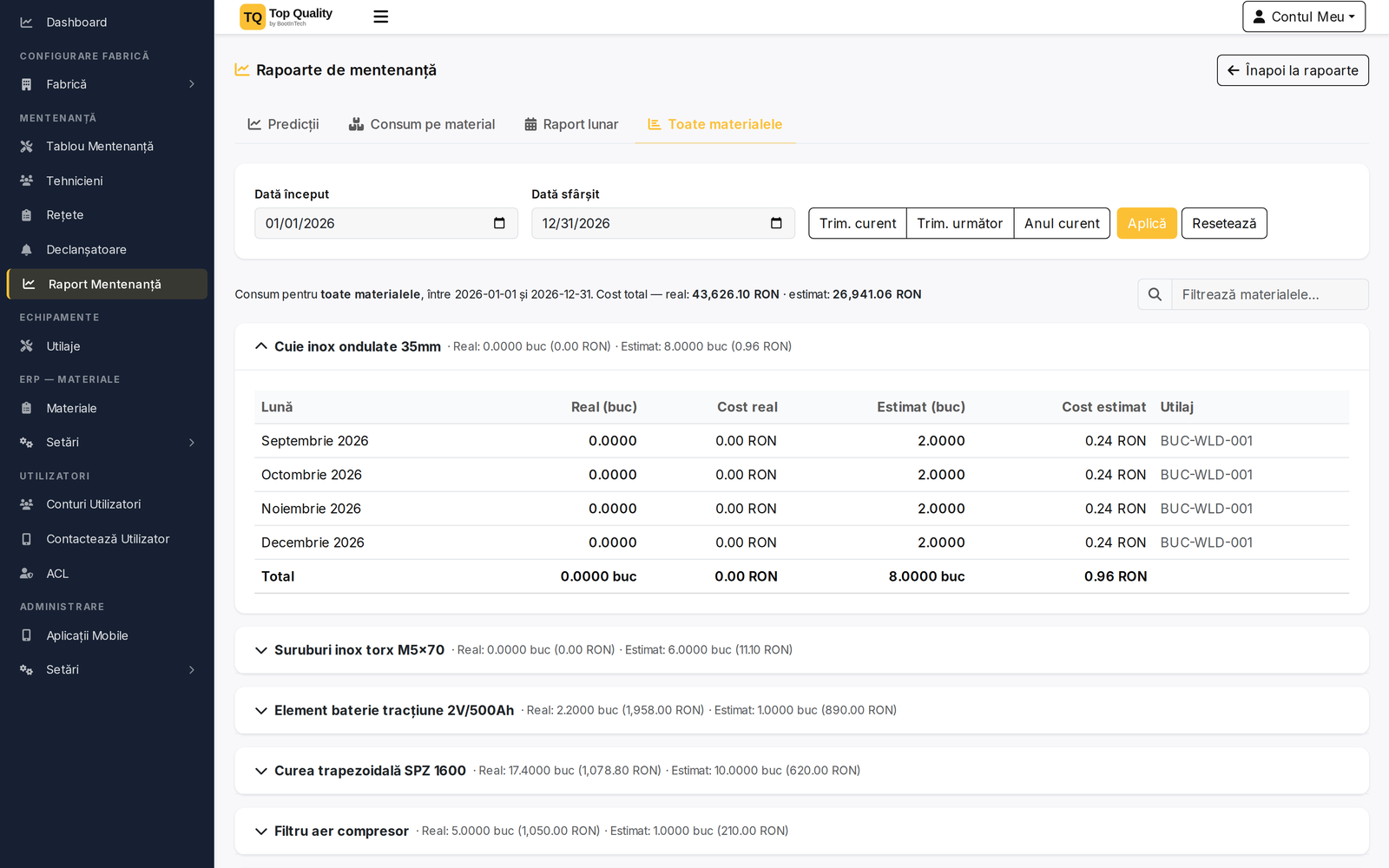
- 07Centralised communication
The conversation with the customer sits next to their order
Correspondence no longer lives in one person's inbox: it is attached to the customer and to their order, so whoever picks up the work sees everything that was said. Email today — WhatsApp is the next step, not something we promise you today.
The customer record gathers quotations, orders, invoices, active projects and the support history in one place.
- 08Lead qualification and follow-up
Requests for quotation stop getting lost between phone calls
Every request enters a pipeline with stages, with a person responsible and the next step written down. The quotation is built from the product catalogue, versioned, cloned for the next variant and sent to the customer as a PDF — not as the third file with the same name.
The pipeline stages are configured around the way you sell, not around the way the software happened to ship.


None of them is missing here
All eight capabilities apply to this industry — which is why it is the first of the ten. On the other pages this space is taken: each one writes here what has no purpose for it, and why.
The same platform, three ways of making things
These are not different modules, they are different configurations of the same system. Each one has a customer in our portfolio.
Windows and joinery
Every window is a one-off product: dimensions given by the customer, profile, hardware, glass. The recipe is written once, on the product type, and the order fills in its own dimensions — nothing is redrawn for each piece. Client in our portfolio: DanProd.
- Orders are placed by dimension: product attributes are configured, not programmed.
- Warranty is tracked by series: every piece leaves with a code that says which profile and glass lot it came from.
- The costing is built from the same recipe the work follows, so the price quoted and the material consumed can be compared on the same order.
Timber frame houses
The project is the house, not the piece. Panels are built in the hall and assembled on site, so the hall and the assembly crew have to see the same list of items, in the same order. Client in our portfolio: Dimmer.
- The house breaks down into panels, the panel into steps, the step into tasks assigned to people and confirmed from a phone.
- Timber traceability: every panel keeps the lots it came from, and the moisture measured at reception is recorded as a control result, not in a notebook.
- The assembly sequence is the one in the system: on site the work follows the order of the steps, with photos attached to the steps that require them.
Steel structures
The structure is cut, welded, dimensionally checked and painted — and the file that ships with it has to show what material it is made of and who welded it. Client in our portfolio: Pallegrini.
- The material certificate is linked to the lot the part was cut from, not to a binder kept on the side.
- The required qualification is written into the work step, and whoever performs the step stays recorded on it.
- Dimensional control and painting are steps with a recorded result and a photo, not ticks on a sheet.
- Steel construction calls for traceability of the material certificate and of the qualified welders — the requirement around EN 1090. That data is collected during execution anyway; the file is assembled from it, rather than from a register kept in parallel.
What changes for each person in the company
Owner
With the platform
On any given day you see what is in progress, what has fallen behind and what the delivered work has cost so far.
Production manager
With the platform
Orders are visible by status, with the person and the machine assigned. A stoppage moves the jobs, not the conversation.
Shop floor operator
With the platform
You scan the workstation, work through the steps on a tablet, record the material used. Time measures itself.
Quality manager
With the platform
You search the product code and you have the lots, the steps, the checks and the people, on one screen.
Maintenance manager
With the platform
Jobs enter the plan on their own, from the rules, and the materials needed for the next 90 days are a list, not a surprise.
| Role | With the platform |
|---|---|
| Owner | On any given day you see what is in progress, what has fallen behind and what the delivered work has cost so far. |
| Production manager | Orders are visible by status, with the person and the machine assigned. A stoppage moves the jobs, not the conversation. |
| Shop floor operator | You scan the workstation, work through the steps on a tablet, record the material used. Time measures itself. |
| Quality manager | You search the product code and you have the lots, the steps, the checks and the people, on one screen. |
| Maintenance manager | Jobs enter the plan on their own, from the rules, and the materials needed for the next 90 days are a list, not a surprise. |
Published figures, not promises
These are results achieved by real customers and already published. The case studies carrying their names go out once they have validated them.
See the platform on your own data
One hour, on the real screens, with your questions. No deck, no commitment.